
When travel disruption occurs, how prepared are your operations to handle the surge, especially when a single cancellation or airspace restriction can drive demand within hours?
A single disruption can quickly increase servicing pressure, requiring teams to manage reissues, amendments, and customer queries at once. According to the International Air Transport Association, global air travel demand grew by 5.3 percent in 2025, with international demand rising by 7.1 percent, reflecting sustained pressure on airline and servicing operations. At the same time, European air traffic control delays have increased by over 114 percent over the past decade, significantly contributing to disruption across flight schedules and passenger movement.
For travel agents, tour operators, and corporate travel businesses, disruption is now a recurring operational challenge. Volume spikes, timelines compress, and teams reach capacity quickly. Effective travel crisis management shifts to structured execution.
This article examines how disruption impacts operations at scale and how a structured travel management solution, supported by reliable travel operations support, ensures operational continuity and travel under pressure.
When Disruption Hits Operations
Disruption rarely remains isolated. A single delay or cancellation quickly spreads across bookings, customer support, and supplier coordination. What starts as a schedule issue becomes an operational load within hours.
The pressure builds across functions at the same time. Booking teams manage changes, support teams handle escalations, and supplier alignment requires immediate action. These activities happen simultaneously, often without additional capacity.
In the crisis management travel industry, disruption does not escalate gradually. It spikes. Businesses that rely only on internal workflows often struggle to maintain pace when volume increases beyond planned capacity.
Where disruption turns operational:
- Booking changes increase across multiple sectors
- Customer queries rise alongside delays
- Supplier coordination becomes time-critical
- Internal workflows lose structure under pressure
Without clear processes and adequate travel operations support, response timelines extend, backlogs grow, and service delivery becomes inconsistent.
Internal Teams Reach Capacity Fast
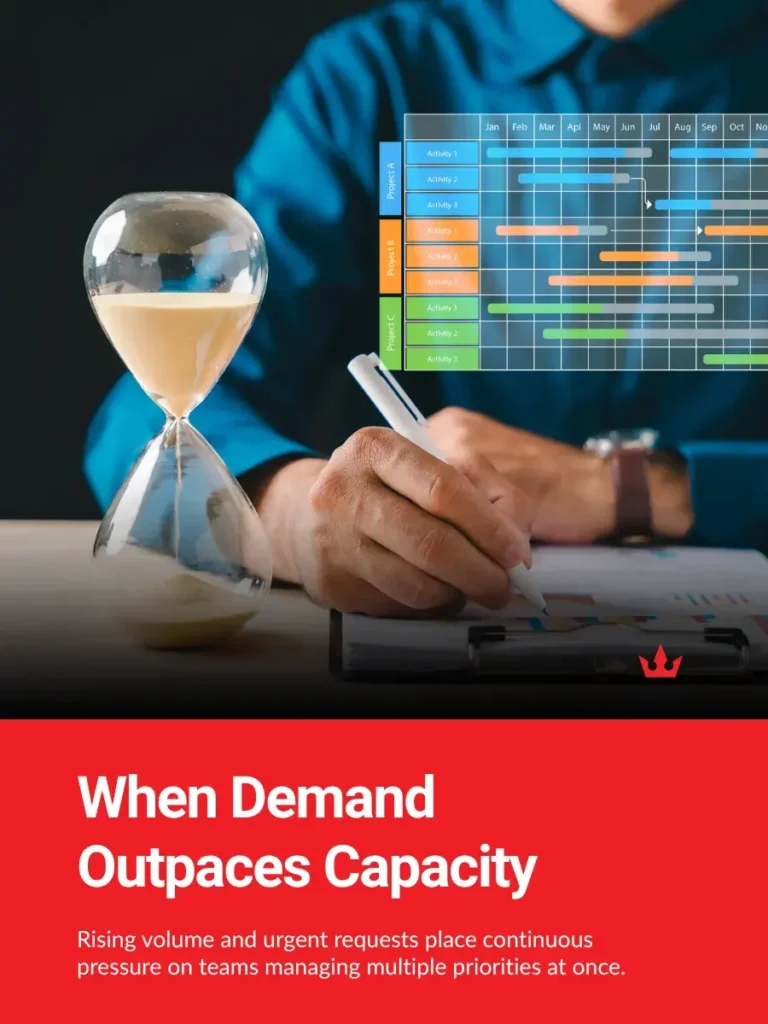
Disruption concentrates the workload into a short timeframe. Reissues, amendments, supplier coordination, and customer queries increase simultaneously, forcing teams to manage multiple priorities without pause.
The challenge is both volume and urgency. Each request carries a time constraint, and delays in one area quickly affect others. Teams are required to respond faster, process more, and maintain accuracy at the same time.
Capacity in most travel businesses is built around predictable demand. Disruption removes that predictability. Workflows slow, response timelines extend, and service consistency becomes difficult to maintain.
Where capacity starts to break:
- Reissues and amendments increase simultaneously
- Customer expectations rise during delays
- Supplier coordination demands immediate action
- Backlogs form as response timelines stretch
For businesses managing travel management, the impact is immediate. Client expectations remain unchanged, even when operations are under strain. Without 24/7 travel assistance, requests continue to accumulate outside working hours, increasing pressure before teams resume.
Without structured travel operations support, teams absorb continuous strain, leading to slower turnaround, increased errors, and reduced control over service delivery.
24 / 7 Support and GDS Expertise Drive Control

Travel operations no longer run on fixed hours. Disruption continues across time zones, and demand does not pause. When coverage stops, pressure builds.
Out-of-hours gaps create an immediate impact. Requests remain unattended, queues expand, and by the time teams resume, the workload has already doubled. In the crisis management travel industry, delayed response is not a minor issue. It directly affects service delivery and contr no ol.
At the same time, handling disruption is not just about availability. It is about execution. Reissues, amendments, and fare recalculations require precision inside live booking environments.
Where operations are tested:
- Requests continue beyond working hours across global markets
- Backlogs form when the response is delayed
- Live booking changes require accurate execution under pressure
- Multi-step processes increase the risk of error
This is where 24/7 travel assistance and strong GDS support services work together. Continuous coverage ensures that requests are handled in real time, while system expertise ensures that every change is executed correctly.
For any travel management company, availability without execution control creates risk. Execution without availability creates delay. Both must work together to maintain stability.
Rebookings Become High-Risk Operations

Rebookings are not routine tasks during disruption. They are high-risk operational activities that require precision under time pressure. Every ticket change, void, or amendment carries dependencies across sectors, fares, and availability.
The complexity increases with multi-sector itineraries. A single change can affect multiple legs of travel, supplier conditions, and pricing structures. When handled under pressure, even small inaccuracies lead to rework, delays, and customer dissatisfaction.
The challenge is balancing speed with accuracy. During disruption, the focus often shifts to clearing volume quickly. This increases the risk of errors, which then require additional handling and extend turnaround times.
Where rebookings start to break down:
- Multi-sector bookings increase dependency risk
- Fare recalculations require precise handling
- Errors trigger repeated processing and delays
- Timelines shrink while volume continues to rise
This is where structured GDS support services become critical. Accurate handling within booking systems ensures that changes are executed correctly the first time, reducing rework and maintaining flow across operations.
Without reliable GDS support services, rebooking pressure compounds quickly. Errors increase, queues grow, and operational efficiency declines.
Support Works Best When It Is Embedded
Support that operates outside the workflow creates delay where speed matters most. During disruption, every handoff adds friction, and every gap slows execution.
Travel businesses require support that aligns with their systems, processes, and timelines. When support functions as part of the internal setup, workflows continue without interruption, and execution remains consistent under pressure.
Where embedded support makes the difference:
- No delays caused by external handoffs
- Continuous workflow across internal and support teams
- Faster response through aligned processes
- Better control over ongoing operations
This approach is critical for maintaining operational continuity travel, especially when disruption compresses timelines and increases workload across all functions.
At the same time, sustained pressure impacts people before systems. Internal teams managing continuous demand, extended hours, and rising expectations begin to slow over time. This affects accuracy, response speed, and overall service quality.
Where operational strain becomes visible:
- Fatigue reduces consistency in execution
- Response timelines extend under continuous load
- Error rates increase as pressure builds
- Service quality begins to fluctuate
For businesses managing corporate travel management, protecting teams is directly linked to protecting service delivery. Without structured support, teams absorb ongoing strain, leading to gradual operational decline.
Integrated travel operations support ensures that workload is distributed effectively, allowing teams to maintain performance without reaching capacity limits.
Operational Stability Drives Performance
Disruption tests how well operations hold under pressure. Speed helps in the moment, but consistency determines outcomes.
When workflows stay aligned, and response remains controlled, service does not break even when volume rises. This is what defines operational continuity travel in practice.
What stability delivers:
- Consistent service during high-pressure situations
- Controlled workflows even as demand increases
- Reliable outcomes without repeated rework
For any travel management company, stability builds long-term trust, strengthens client relationships, and ensures operations remain dependable across cycles of disruption.
Control Holds When Pressure Builds
Disruption does not test speed. It tests control under pressure.
For travel agents, tour operators, and corporate travel managers, the impact is direct. Without structure, workflows slow, teams reach capacity, and service declines. With the right setup, operations remain stable and performance is maintained.
At this point, travel crisis management is essential. A structured travel management solution, supported by reliable operations support, ensures continuity during demand spikes.
If operations rely on reacting faster, the risk is already built into the system. Strengthen control with Technomine Travel Solutions before disruption exposes operational gaps.