
A travel team may finish for the day, but the bookings it manages do not follow the same schedule. Schedule changes, urgent amendments, cancellations, supplier requests, and traveller requirements can arise at any hour, sometimes requiring action before the next working day begins.
The OECD Tourism Trends and Policies 2026 highlights this operational reality, reporting that tourism businesses face increased administrative demands when managing operational changes and flexible itineraries during periods of travel disruption and uncertainty.
For travel agencies, tour operators, OTAs, and TMCs, effective travel management solutions need to support continuity beyond standard office hours. Continuous operational coverage can help teams manage time-sensitive booking requirements, reduce pending workloads, respond to urgent requests, and maintain service continuity across different hours and time zones.
This article examines how 24/7 operational support can help travel businesses respond faster, manage workloads more effectively, reduce operational delays, and keep essential booking and traveller requirements moving.
Why After Hours Travel Support Matters
A traveller needing an urgent booking change at 10 pm does not see it as tomorrow morning’s task. For the travel business handling that booking, limited coverage outside working hours can leave the request pending, make the situation harder to resolve, and start the next shift with an avoidable backlog.
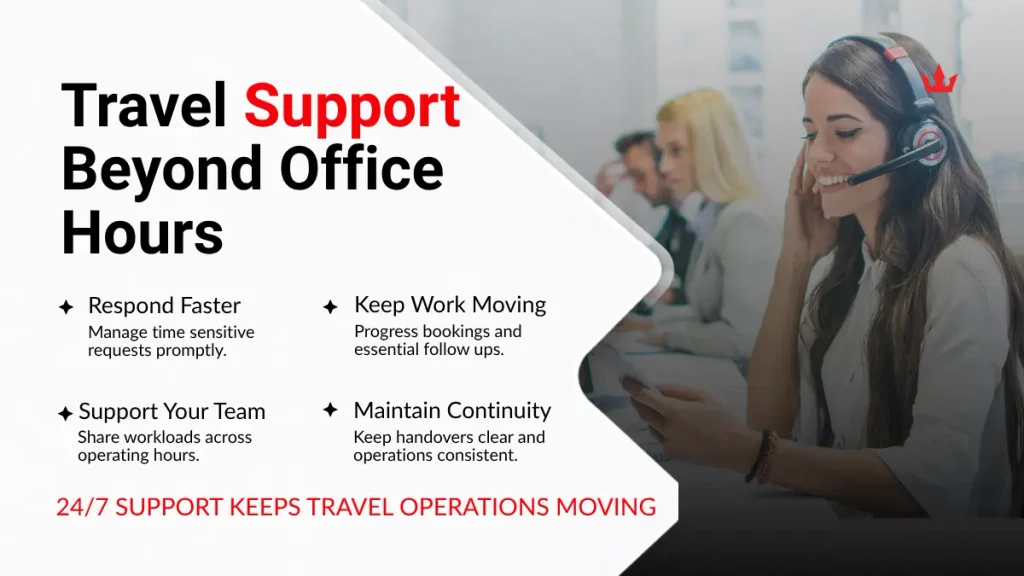
Effective after-hours travel support gives travel businesses operational coverage when their regular team is unavailable. This can help teams:
- Respond to urgent booking amendments and cancellations sooner.
- Manage schedule changes and time-sensitive reservation requirements.
- Keep essential supplier and traveller communication moving.
- Reduce unresolved tasks passed to the next working shift.
- Maintain coverage during evenings, weekends, and public holidays.
The value is not simply being available around the clock. It is ensuring that an urgent request does not become a larger operational problem because it arrived outside office hours.
Managing Urgent Requests Without Disrupting Operations
Urgent travel requests rarely arrive one at a time. A reservations team may be processing new bookings when an existing traveller needs an immediate amendment, a cancellation requires action, or a supplier needs confirmation. The challenge is deciding what requires immediate attention without allowing every incoming request to disrupt the wider operation.
A structured approach to urgent request management can help teams:
- Identify requests that genuinely require immediate action.
- Assign urgent cases to available operational resources.
- Escalate complex requirements to the appropriate team.
- Maintain clear visibility of completed and outstanding actions.
- Protect routine reservations and booking work from unnecessary disruption.
Good urgent request management is not simply about responding faster. It helps critical cases receive appropriate attention while the rest of the operation continues to function effectively.
Reducing Delays Across Tour Operations Management
Operational delays are not always caused by major travel disruptions. A booking amendment waiting for confirmation, an unanswered supplier request, or an incomplete handover can be enough to slow the next stage of work. As smaller delays accumulate, teams can spend valuable time clearing yesterday’s workload before addressing today’s priorities.
Within tour operations management, continuous operational coverage can help by:
- Following up on outstanding booking requirements before they accumulate.
- Keeping booking information current as actions are completed.
- Maintaining clear handovers between teams working different hours.
- Identifying unresolved cases that need further attention.
- Escalating time-sensitive issues before they affect later stages of the booking.
Reducing these operational gaps gives teams greater control over their workload and helps each working period begin with clearer priorities rather than yesterday’s unfinished tasks. For businesses looking at the wider impact of disruption, travel crisis management in modern travel operations provides further context on maintaining operational control when travel plans change.
Improving Efficiency Without Overloading Internal Teams
Busy travel teams can spend much of their day moving between reservations, amendments, supplier follow-ups, ticketing requirements, and traveller enquiries. When urgent work is added to an already full workload, efficiency can suffer even when everyone is working at capacity.
For smaller travel businesses assessing small business travel solutions, maintaining internal resources across every shift or time zone may not always be practical. Additional operational coverage can help businesses:
- Keep essential work progressing outside core operating hours.
- Reduce the morning backlog created by overnight requests.
- Give internal teams more capacity for complex cases and business priorities.
- Provide additional coverage during periods of higher booking activity.
- Distribute workloads more effectively instead of continually adding pressure to the same team.
Operational efficiency is not about asking people to handle more in less time. It comes from using available resources effectively so internal teams can focus their attention where it creates the most value.
Maintaining Service Continuity Across Every Hour
Service continuity becomes particularly important when travellers, suppliers, and booking teams operate across different time zones. A request received after one team finishes its day may need attention before that team returns. Without adequate coverage, even a straightforward requirement can remain unresolved for hours and affect the next stage of a booking.
Reliable traveller support services can help maintain continuity by:
- Acknowledging traveller requests that require timely attention.
- Progressing booking requirements that cannot reasonably wait.
- Keeping travellers informed when further action is required.
- Recording actions so the next team has the necessary context.
- Maintaining visibility of cases that remain unresolved.
Consistent service does not mean promising an immediate resolution for every request. It means important requirements remain visible, receive appropriate attention, and are handed over properly when further action is needed.
Supporting Business Travel Solutions Across Time Zones
Corporate travellers often work to schedules that leave little room for unresolved travel arrangements. Early departures, international connections, meetings, accommodation requirements, and onward travel can all be affected when an itinerary changes outside regular working hours.
For providers of business travel solutions, extended operational coverage can help teams:
- Address urgent itinerary changes across different time zones.
- Keep corporate travellers informed when arrangements change.
- Review how a change could affect connecting travel or accommodation.
- Progress time sensitive requirements before the next working shift.
- Maintain clear booking records for corporate travel teams and TMCs.
A corporate travel change can affect more than one reservation. Keeping related requirements moving helps protect the wider itinerary while reducing the number of unresolved cases waiting for the regular team.
Building Stronger Travel Operations With Continuous Support
24/7 operational support delivers greater value when it becomes part of the wider operating structure rather than a service used only when something goes wrong. Availability alone is not enough. Clear responsibilities, consistent processes, accurate handovers, and defined escalation routes help teams work across different hours without creating confusion.
Travel businesses should consider:
- Which requests require immediate action and which can wait.
- Who is responsible for specific tasks across operating hours.
- How booking and traveller information should be recorded.
- When complex cases need to be escalated.
- How outstanding requirements will be handed over to the next team.
For travel agencies, tour operators, OTAs, and TMCs, this structure can give reservations, ticketing, operations, and customer service teams a clearer view of what has been completed and what requires attention next.
Continuous coverage works best when every team understands its role. That clarity turns 24/7 support into a practical part of everyday operations rather than simply additional availability.
Keep Travel Operations Moving
Travel requirements do not always follow business hours. Effective travel management solutions can help travel agencies, tour operators, OTAs, and TMCs manage urgent requests, reduce pending workloads, and maintain service continuity across different hours and time zones.
With the right support in place, internal teams can stay focused while essential booking and traveller requirements continue to move forward.
Keep critical travel operations moving around the clock. Connect with Technomine Travel Solutions for dependable 24/7 operational support.
